
A Witty Rediscovery: We Happy Few's The Mannequin at Capitol Hill Arts Workshop
There is a particular thrill in watching a play that almost no one has seen, especially when it turns out to be as sharp, funny, and quietly radical as The Mannequin. We Happy Few has brought this rarely produced 1811 comedy by Germaine de Staël to the Capitol Hill Arts Workshop, where it plays through June 6, 2026, and the result is a fast, feminist, and genuinely delightful evening of theatre that proves wit never really goes out of style.
De Staël herself is reason enough to take notice. A formidable intellectual who lived through Parisian life before and after the French Revolution and was eventually exiled from the city by Napoleon Bonaparte, she spent her mature years traveling across Europe and sharpening a philosophy that ranged far beyond the drawing room. She wrote The Mannequin during that exile, and the play arrives here as part of We Happy Few's ongoing commitment, in partnership with the Expand the Canon initiative, to uncover and uplift classic works by women and underrepresented playwrights whose voices deserved the spotlight all along. Translated by Vivian Folkenflick and directed by Kerry McGee, this production rescues a small gem from obscurity.
The story unfolds within a French refugee family living in Berlin. Monsieur Morlière, the family patriarch, is hopelessly obsessed with all things French, clinging to a romanticized vision of an ancestral homeland he has spent his life dreaming about. In his desperation to preserve that connection, he arranges for his bright and independent daughter, Sophie, to marry a French aristocrat, Monsieur de Ville, a man who is less an ardent suitor than a walking monument to his own vanity. The trouble is that de Ville is far more in love with Sophie's inheritance than with Sophie, and Sophie, for her part, would much rather give her heart to Frederich, a sincere and modest German painter who actually sees her.
Recognizing that her would-be groom is incapable of listening to anyone but himself, Sophie devises a wonderfully absurd plan: she sets out to prove that the self-absorbed Count could not tell the difference between a living, breathing woman and a dressed-up mannequin. What follows is a brisk and sharp-tongued farce that pokes at marital autonomy, cultural snobbery, and the superficiality of high society, all while letting Sophie quietly operate several moves ahead of every man in the room. She is the strategist of her own fate in a world that grants women very little room to maneuver, and her cleverness gives the comedy its spine.
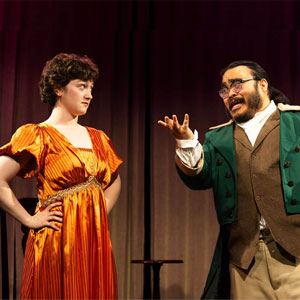
The ensemble brings the period and the play's comic engine to vivid life. Gill Rydholm anchors the production as Sophie with a light, agreeable charm that masks a master tactician orchestrating the egos around her. Em German turns Monsieur de Ville into a glorious caricature of self-regard, preening and posturing as though the entire universe were a mirror arranged for his benefit. Andrew Quilpa gives Monsieur Morlière an energetic, tragicomic yearning, capturing the ache of an exile devoted to a country he has never actually seen, and Esteban Marmolejo-Suarez lends Frederich a grounded, endearing sincerity that makes him the obvious answer to Sophie's affections. Even the silent mannequin at the center of the scheme manages to say a great deal while saying nothing at all.
The staging keeps the focus where it belongs, on the language and the performers. Jon Reynolds' scenic design is elegantly sparse, a clean, curtained backdrop and a few well-chosen furniture pieces that lend the space the intimacy of a salon. Wendy Snow Walker's costumes evoke the Regency era with grace, dressing Sophie and her silent double in a way that underlines the visual joke at the heart of the play.
What ultimately distinguishes The Mannequin from the average social satire is its compassion. De Staël does not merely mock vanity and aristocratic pretension; she understands the systems that produce them and treats her characters less as villains than as people trapped within roles they no longer know how to escape. That nuance keeps the comedy from turning preachy and lets it land as both a farce and a genuinely forward-thinking piece of feminist theatre. Written at a time when de Staël's own daughter was approaching marrying age, the play imagines a future in which women possess real agency, and it uses the tools of comedy to sketch that future out.
Running approximately 70 minutes with no intermission, The Mannequin is a breezy, intelligent, and thoroughly entertaining night out, and a rare chance to encounter a nineteenth-century French rom-com that more than earns its moment onstage. We Happy Few presents The Mannequin through June 6, 2026, at the Capitol Hill Arts Workshop, 545 7th St SE, Washington, DC.