
Faction of Fools Brings a Sun-Drenched Much Ado About Nothing to Capitol Hill Arts Workshop
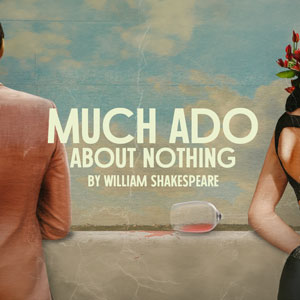
If you have ever wondered what it feels like to step into a Sicilian vacation and a Shakespeare comedy at the same time, Faction of Fools has the answer. The company's production of Much Ado About Nothing, now playing at Capitol Hill Arts Workshop through May 2, 2026, is a spirited, sun-drenched triumph that blends the Bard's most beloved romantic comedy with the ancient art of Commedia dell'Arte — and the pairing turns out to be nothing short of inspired.
Faction of Fools is Washington DC's only theatre company dedicated exclusively to the Commedia dell'Arte form, a Renaissance-era performance style rooted in masked archetypes, improvisation, and exuberant physical comedy. The company has made its home in the intimate black box at Capitol Hill Arts Workshop, and for this production, scenic designer Johnny Weissgerber has transformed that space into the Hotel Bella Figura — a plush, present-day Sicilian resort complete with a reception desk, a wall of hotel keys, and three arches that become doorways, balconies, and dramatic frames depending on the moment. Audiences enter through the hotel lobby itself, finding themselves already inside the world of the play before a single line is spoken. It is an immediately transporting effect, and the production never loses that warm Mediterranean glow.
The script, adapted by director Natalie Cutcher along with Matthew R. Wilson and Co-Artistic Director Kathryn Zoerb, strips away the play's more obscure tangents and tightens its focus on the emotional core: two very different love stories unfolding at the same resort. Claudio (Lorenzo Miguel) and Hero (Jasmine Proctor) fall for each other in a cartoon-like rush of first-sight infatuation, while Beatrice (Mary Myers) and Benedick (Danny Puente Cackley) spend the better part of the evening pretending they want nothing to do with each other. The comedy, of course, is that everyone in the hotel can see what they cannot. When the scheming Don John — also played by Myers — sets out to destroy Hero's reputation and Claudio's trust, the play swerves into darker territory, raising pointed questions about rumor, shame, and the social pressures placed on women. The production handles this tonal shift with care, keeping the comedy alive while never softening the sting.
The cast of six plays a total of sixteen characters, each differentiated by a change of mask, costume, and physicality. This kind of doubling could easily become confusing, but Cutcher's precise direction ensures every character is distinct and fully inhabited. Myers is a tour de force as Beatrice, bringing both sharp wit and genuine vulnerability to the role, while her Don John is a creature of cold menace — hands curled like paws, posture coiled with malice. Cackley's Benedick fills the stage with swagger and charm, and his solo scene during the "This can be no trick" monologue is one of the production's finest moments, aided by William K. D'Eugenio's lighting, which isolates him in a private pool of contemplation while the world around him freezes. Proctor moves seamlessly between the tenderness of Hero and the bravado of Borachio, and Miguel brings a beautifully cartoonish ardor to Claudio's infatuation, even as he finds more grounded moments later in the play.
It is Matthew Pauli, however, who earns some of the biggest laughs of the evening in his triple role as Leonato, Dogberry, and Verges. His Dogberry — a master constable with a broad Scottish accent and a gloriously mangled command of the English language — is a delight on its own. But Pauli also voices and operates Verges as a puppet in several scenes, giving rise to a one-man showstopper that must be seen to be believed. Francesca Chilcote rounds out the ensemble with poise and energy, particularly in the show's precisely choreographed opening sequence, which sets the whole evening's breezy tone.
D'Eugenio's lighting design is one of the production's quiet stars, shifting through jewel tones that pulse with personality and occasionally breaking into playful shadow work. Kenny Neal's sound design draws almost entirely from Italian opera, with Verdi, Puccini, and Ponchielli providing a lush, comedic underscore — Benedick's theme is "La Donna è Mobile," which tells you everything you need to know about how the production regards his romantic self-image. Cidney Forkpah's costumes lean into the resort setting, giving the cast a breezy, summery elegance that makes the hotel feel entirely real. The masks themselves, crafted by Tara Cariaso of Waxing Moon Masks, are expressive and beautifully designed, and the production wastes no time in proving that masked actors can communicate enormous emotional range through posture, gesture, and voice alone.
Commedia dell'Arte emerged in 16th-century Italy as a popular form that celebrated the powerless and satirized authority, and Cutcher's production keeps that subversive spirit alive. The gender dynamics at the heart of Much Ado — Hero's public shaming, Beatrice's frustrated anger at being barred from the action by virtue of her sex — land with unexpected force in this cheerful, sun-lit setting. The contrast between the comedy's surface and its underlying critique makes the play feel urgently alive rather than merely historical.
Much Ado About Nothing runs approximately two hours and twenty minutes with a one ten-minute intermission and is suitable for families, with some PG-13 humor. The show plays through May 2, 2026 at Capitol Hill Arts Workshop, 545 7th Street SE, Washington, DC. Tickets and more information are available at factionoffools.org.