
Scena Theatre Finds the Humor in Hell with No Exit at Atlas Performing Arts Center
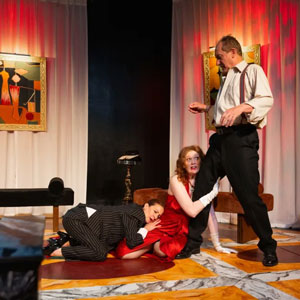
Jean-Paul Sartre's "No Exit" ranks as one of the classics of the modern theatre. The one-act philosophical play by the French Nobel Laureate was first performed in 1944 in Occupied Paris and later published in 1945. Its original French title, "Huis clos," is sometimes translated as "In Camera" or "Dead End." Now Scena Theatre brings this landmark of existentialist drama to Lab Theatre II at Atlas Performing Arts Center, where it plays through July 19, 2026.
Most theatregoers know the play's central premise even if they have never seen it staged. Three recently deceased strangers are escorted, one by one, into a single locked room in the afterlife. There are no flames, no torture devices, and no demons. Instead, Sartre's great insight is that the damned will torment each other, a realization that culminates in the play's most quoted line: hell is other people. What may surprise audiences at this production is how much laughter Scena Theatre and director Robert McNamara have found inside that grim scenario.
The room itself sets the tone. Scenic designers Carl Gudenius and Michael Stepowany have created an unexpectedly stylish inferno, with three sleek divans arranged on a patterned marble floor beneath a trio of vividly lit abstract paintings. It looks less like a torture chamber and more like the work of an ambitious interior decorator, which is exactly the joke. When Garcin (Stas Wronka), a journalist executed by firing squad, is ushered in by a wry, bellhop-like Valet (Kim Curtis), he keeps waiting for the instruments of punishment to appear. They never do. The punishment walks in the door behind him.
First comes Inez (Luz Nicolás), a sharp-tongued sadist in a mannish pinstriped suit who seduced her cousin's wife and psychologically tortured the woman into a murder-suicide that claimed them both. Nicolás plays her with gleeful, cartoonish menace, and her pointed glances at the audience land as reliable comic beats. Then arrives Estelle (Danielle Davy), a vain, beautiful socialite in a burgundy gown who insists her presence in hell must be a clerical error. She is not nearly as innocent as she claims, having drowned her illegitimate baby and driven her lover to suicide. Estelle craves male attention, Garcin craves the company of women, and Inez watches them both with jealous, unblinking eyes. The triangle is complete, and eternity begins.
McNamara directs the piece briskly, leaning into the material's potential as both parlor-game farce and borderline erotica. The three damned souls flirt, dance, taunt, and confess, with choreography by Kim Curtis and intimacy coordination by Paul Gallagher, who fittingly also serves as fight director. The physical comedy plays in constant tension with the darkness underneath, because for all the wit on the surface, Sartre's play remains a serious examination of moral responsibility and our shallow obsession with how others perceive us. These characters know exactly why they are in hell. They simply prefer to call themselves absent rather than dead.
Some of the production's strongest moments come when the characters peer back through the veil at the world of the living. Gudenius's lighting design shifts to a crack of light across their faces as they watch how quickly the earth has moved on without them, while Brandon Cook's sound design keeps a low, ominous drone humming beneath the gentility, punctuated by the slam of an enormous unseen door. Each character also gets plaintive, self-justifying monologues delivered straight through the fourth wall, spotlit to sharp effect. Alisa Mandel's costumes do smart characterizing work throughout, from Inez's severe tailoring to Estelle's glamorous gown.
The result is a production that treats a famously dour text with a knowing wink, letting the actors play their doomed characters with a satirical edge that keeps the evening lively without diminishing the play's ideas. It is a fresh answer to the question of why anyone should leave home to spend nearly two hours with three of the damned, and the answer turns out to be that they are surprisingly good company.
"No Exit" runs one hour and 50 minutes with no intermission. The production is performed in the Paul Bowles translation and contains mature content, including references to self-harm, suicide, sexual assault, grief, and infant loss, along with frequent sexual content and violence.
"No Exit," presented by Scena Theatre, plays through July 19, 2026, in Lab Theatre II at Atlas Performing Arts Center, 1333 H Street NE, Washington, DC.