
Our Town at American Shakespeare Center in Staunton
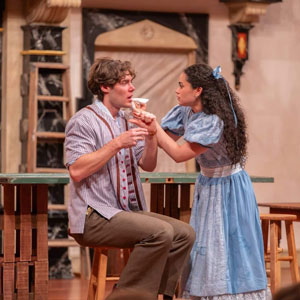
Some plays reward you for coming back to them, and Thornton Wilder's Our Town may be the clearest example in the American canon. The characters are familiar, the shape of the story is known, and yet every new production seems to surface something that was hiding in plain sight. American Shakespeare Center's summer staging, playing at the Blackfriars Playhouse in Staunton, Virginia, is that kind of production — clear-eyed, warmly acted, and unafraid of the shadows Wilder wrote into the script.
Directed by ASC veteran K.P. Powell, the production leans into the intimacy of the Blackfriars space, where shared lighting and close quarters put the audience inside the life of Grover's Corners rather than at a polite distance from it. Ronald Román-Meléndez leads the ensemble as the Stage Manager, that peculiar figure who narrates, interrupts, and quietly presides over the births, marriages, and deaths of a small New Hampshire town at the turn of the twentieth century. He plays the role with the emotional remove Wilder wanted — an observer rather than a sentimentalist — and the play is stronger for it.
Wilder famously insisted on a bare stage, and the production honors that instruction. Ladders, crates, unused doors, and odds and ends of furniture do all the scenic work, which has the double effect of foregrounding the actors and reminding you of the improvisational ingenuity that has powered theatre companies for centuries. Nothing stands between the audience and the people onstage.
At the center of the story is the courtship of George Gibbs and Emily Webb, the boy and girl next door whose ordinary romance carries the weight of the entire play. Nick Ericksen and Isabel Sanchez bring genuine warmth to the pair, along with the flashes of friction and nerves that make the relationship feel lived-in rather than idealized. Their wedding-day panic, and the way their families rush to steady them, lands as recognizably as ever: whenever and wherever you marry, there is a moment of understanding that nothing will be quite the same again.
The surrounding town is drawn with equal care. Summer England's Mrs. Gibbs quietly carries the ache of a woman who has spent her life imagining a world beyond the county line, while Christopher Seiler's Dr. Gibbs anchors the household with steady practicality. Morgan Rose Ford plays Mrs. Webb as a study in no-nonsense pragmatism, refusing the easy sentimentality that so often creeps into portrayals of small-town motherhood, and Aidan O'Reilly's Mr. Webb is the town's solid civic pillar. Hannah Nguyen is endearing as George's younger sister Rebecca, and moves nimbly among several other townspeople; Geoffrey Warren Barnes II charms as milkman Howie Newsome, whose reliable horse and wagon exist entirely in the audience's imagination. Angela Iannone's Simon Stimson, the church choir director whose private struggles resist every offered hand, gives the production its sharpest edge and dispels any lingering notion that small-town life is uniformly gentle.
The production also threads in a striking set of musical selections, drawing on contemporary songs that alternate between melancholy and exuberance and setting the emotional temperature for each of the three acts. It is a reminder that Wilder himself bristled at having his play filed away as cheerful nostalgia. He wrote about mortality, routine, and the difficulty of paying attention to your own life while you are living it, and this staging keeps that balance of light and darkness intact.