
Maybe Happy Ending Brings Its Tender Robot Love Story to The National Theatre
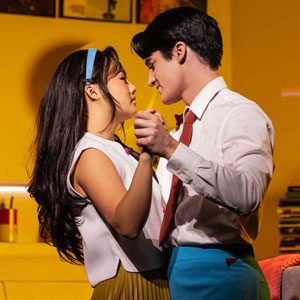
Love, it turns out, isn’t only for humans. Maybe Happy Ending, the six-time Tony Award winner for Best Musical, has landed at The National Theatre as part of Broadway at the National, and its story of two lonely robots who stumble into something like love is winning over Washington audiences through October 11, 2026. Created by South Korean lyricist Hue Park and American composer Will Aronson, who wrote the book together, and directed by Tony winner Michael Arden, the musical carries a quirky premise that gives way to something deeply human.
The story is set in a retro-futuristic Seoul of the near future, where Oliver and Claire are “helperbots,” domestic androids who have been declared obsolete and now live out their days as neighbors in an apartment complex for retired robots. Oliver is an older, more rigid Model 3 who keeps to his routines and waits faithfully for the return of his former owner, James. Claire is a newer, sharper Model 5 with a more cynical streak. Their first meeting is hardly romantic, since Claire simply needs to borrow Oliver’s charger before her battery runs out, but the prickly acquaintance slowly warms into friendship. When the pair set off together on a road trip to Jeju Island so Oliver can find James, they encounter the human world, the natural world, and eventually feelings their programming never prepared them for, including love and the knowledge that nothing lasts forever.
Steven Huynh and Claire Kwon, both veterans of the Broadway production, lead the tour, and their performances are drawing some of the warmest praise. Huynh gives Oliver a gentle, sweet innocence, and his physical work is especially striking as he gradually lets the character’s crisp robotic movements loosen into something more fluid and human as Oliver’s inner life grows. His smooth, jazz-tinged voice shines on “Where You Belong.” Kwon brings commanding vocal power and a wide range to Claire, moving effortlessly from quiet, conversational moments to soaring belts in numbers like “When You’re in Love” and “The Rainy Day We Met.” Together they find every emotional beat in Aronson and Park’s lovely score.
The supporting cast is just as strong. James Seol plays two roles, Oliver’s former owner James and James’s estranged son Junseo, and his duet with Huynh beautifully captures the bond between a man and his devoted robot companion. Francisco Javier Gonzalez nearly steals the show as Gil Brentley, a 1930s-style jazz crooner who weaves through the story commenting on the action in song. With a smooth Sinatra-like swagger and easy charm, he opens the evening by posing the question at the heart of the show: if every love eventually ends in loss, why bother loving at all?
Then there is the stunning production design, which audiences will be talking about long after the curtain comes down. Scenic designer Dane Laffrey and video designer George Reeve, along with lighting designer Ben Stanton, have built a world inspired by 1970s Japanese architecture in which the robots’ tiny, confined apartments slide away on massive turntables to reveal sweeping outdoor landscapes. Hundreds of video tiles cover the walls, ceiling, and floor, and 3D holographic imagery lets the actors interact with an environment that feels fully alive. A neon-lined iris system even opens and closes around the action like a smartphone screen, guiding the audience’s eye with cinematic precision. A seven-piece orchestra under music director Josh Tatsuo Cullen gives the score a rich, intimate sound.
Running one hour and 40 minutes with no intermission, Maybe Happy Ending makes for a moving and manageable night out, and it is recommended for ages 8 and up. Beneath the robots and the dazzling technology is a bittersweet reminder to step out of our routines, take a chance on connection, and treasure the people who stay beside us. This is the last weekend to catch it.
Maybe Happy Ending plays through October 11, 2026, at The National Theatre, 1321 Pennsylvania Avenue NW, Washington, DC.