
Big Band Meets Symphony at Wolf Trap
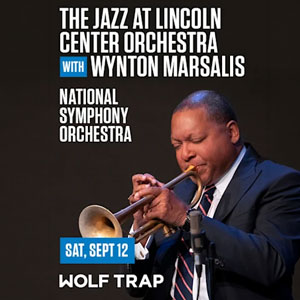
There are concerts you attend, and there are concerts you tell people about for the next twenty years. On Saturday, September 12, the Filene Center at Wolf Trap hosts one that has a real chance of landing in the second category: Wynton Marsalis and the Jazz at Lincoln Center Orchestra join the National Symphony Orchestra for the premiere of Marsalis' Symphony No. 5, "Liberty," a sprawling new work written for the nation's 250th birthday and co-commissioned by the NSO and the Wolf Trap Foundation for the Performing Arts. James Gaffigan conducts. Curtain is 8 PM, and the gates open at 6:30.
The piece has been one of the most anticipated American commissions in years, and it arrives at Wolf Trap carrying a bit of drama of its own. "Liberty" was originally slated to debut in Philadelphia in late May, with a follow-up performance at Carnegie Hall as part of that hall's America250 festival. Weeks before the downbeat, Marsalis and the Philadelphia Orchestra jointly announced a postponement, saying that a large-scale commission evolves throughout the creative process and that everyone involved agreed more time would serve the symphony's long-term life. The reasons went no further than that, and the Philadelphia and Carnegie audiences heard selections from Marsalis' Symphony No. 4, "The Jungle," instead. Which means the score that arrives in Vienna, Virginia, in September has had an extra summer of shaping — and that the Filene Center crowd will be among the first people on earth to hear it.
What makes "Liberty" worth the anticipation is the collision at its center. Marsalis has spent four decades arguing, in print and on the bandstand, that jazz is not a genre tucked into a corner of American music but the thing American music is made of. His symphonic writing has always been the proof: a 15-piece big band and a full orchestra sharing a stage, blues form leaking into sonata form, a rhythm section keeping time under a string section that was never taught to swing. "Liberty" applies that method to the American story itself, and it was conceived from the outset as a work that would make room for the voices that were not fully heard in 1776. Expect something closer to a national argument set to music than a birthday card.
The forces onstage are considerable. The Jazz at Lincoln Center Orchestra is, by common agreement, the finest big band working today — fifteen musicians who are also composers, arrangers, and bandleaders in their own right, and who have made a specialty of playing the whole history of the music, from Jelly Roll Morton to premieres finished last week. The National Symphony Orchestra has spent 55 summers as Wolf Trap's resident orchestra, and the Filene Center's open-sided shell has a way of giving orchestral sound a warmth and immediacy that no concert hall quite replicates. The evening opens with a set of selections from the JLCO before the two ensembles combine for the symphony.
There is also a note of farewell running underneath the whole thing. In January, Jazz at Lincoln Center announced that Marsalis will step down as Artistic Director and as Music Director of the JLCO at the end of the 2026–27 season, closing out nearly forty years at the helm of an institution he founded as a modest summer concert series when he was 26. He'll move into an advisory role as Founder in July 2027 and remain on the board thereafter. He is 64, still playing brilliantly, and still writing at scale — but this is his last season leading the band he built, and every date on the calendar carries that weight. Seeing him conduct and play a new symphony with this orchestra, in this season, is not a thing that will come around again.
Get there early. At 7 PM on the Farmhouse Lawn, just left of the main gate, Wolf Trap hosts a free pre-performance discussion with Davey S. Yarborough, co-founder and artistic director of the Washington Jazz Arts Institute, and Murray Horwitz — the Tony-winning co-creator of Ain't Misbehavin' and host of WAMU's The Big Broadcast. For a piece this ambitious, forty minutes of context from two people who know the music this well is genuinely worth the earlier arrival.