
A Rollicking, Modern Emma Charms Audiences at Everyman Theatre
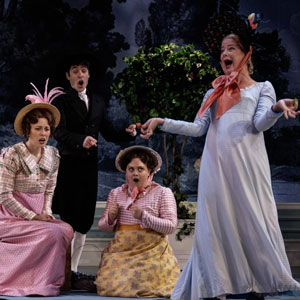
Jane Austen gets a delightfully irreverent makeover at Everyman Theatre, where Kate Hamill's witty, fast-paced adaptation of Emma closes out the company's 2025/2026 season with two and a half hours of full-tilt rom-com mayhem. Directed by Laura Kepley, this reimagined Regency romp keeps Austen's beloved meddling matchmaker at the center of the action while spinning her world into a thoroughly modern comic confection. The result is a production that has been hailed as lively, laugh-filled, and bursting with theatrical invention from curtain to curtain.
The story will be familiar to Austen devotees. Emma Woodhouse, convinced of her unmatched gifts as a romantic strategist, sets about engineering matches for everyone in her orbit, with predictably catastrophic and hilarious results. Along the way she misreads nearly every situation, particularly her own simmering feelings for the exasperated and exasperating George Knightley. Hamill's adaptation preserves the comic spine of the novel while heavily compressing the plot, breaking the fourth wall, and turning the volume up on every gag, gesture, and barbed exchange. It's an Emma designed to delight longtime Austen readers, newcomers, and anyone who simply loves a smartly constructed laugh.
What audiences seem to love most is just how successfully the production blends Regency-era elegance with present-day comic sensibility. The set, anchored by graceful grisaille forest murals and a shimmering chandelier, is undercut by disco balls, flashing lights, and a sound design that drops the action squarely into 1980s party territory during scene changes and dance numbers. The choreography ditches the cotillion in favor of funky, vivacious movement that has been singled out as one of the production's biggest crowd-pleasers. The costumes maintain the silhouettes of the period but bathe each character in a signature palette — Emma in confident pink, Harriet in blinding sunshine yellow, Jane Fairfax in icy blue, and Frank Churchill in a slightly cheeky purple — turning the wardrobe itself into a witty form of characterization.
Katie Kleiger anchors the production as Emma with what has been described as a comic tour-de-force, slipping fluidly between fourth-wall-breaking asides and the chaos of scene work without ever losing her grip on the character's emotional truth. Her chemistry with Tony K. Nam's Knightley is one of the production's great pleasures, reading by turns as warring siblings, sworn enemies, and obviously smitten almost-lovers. Their bickering, sparring, and reluctant tenderness fuel the rom-com engine, and the adjustment to make the two characters closer in age and shared history has been praised for finally letting their romance feel like a true meeting of equals rather than a mismatched pairing.
The supporting ensemble draws nearly as much enthusiasm. Nia Zagami brings infectious, bubbly energy to Harriet Smith, charting the character's arc from stammering naïveté to genuine self-possession, and even claiming the play should really be called Harriet. Zack Powell takes on all three of Emma's would-be suitors, distinguishing each with such clarity and physical specificity that his triple duty becomes one of the show's recurring delights. Megan Anderson has been singled out repeatedly for her chameleon-like virtuosity, whip-snapping between the squealing absurdity of Mrs. Elton and the demure stillness of Jane Fairfax in full view of the audience, often to ovations. Beth Hylton lends warmth and well-timed wisdom as Mrs. Weston, Jefferson A. Russell finds rich comedy in his grumbling Mr. Woodhouse (whose mere mention of "gruel" reliably brings down the house), and Helen Hedman charms and disarms as the fluttering Miss Bates. A running gag in which whichever actor happens to be free at the moment plays the silent, twitching "Mother" has emerged as one of the production's most beloved bits.
Beyond the laughs, what audiences are taking away is the production's genuine heart. Kepley's staging earns its loudest reactions through farce, but it also pauses for a striking late-act moment of emotional reckoning, beautifully supported by a teal wash of light, that grounds the comedy in real feeling. The adaptation also amplifies the feminist undercurrent that Austen only hinted at, building toward an ending in which Emma and Knightley arrive on genuinely equal footing and look forward to a future their daughters can fully inherit. It's a fresh, funny, and surprisingly moving evening of theatre that proves Austen still has plenty to say to a modern audience, especially when she's allowed to laugh along with us.
Emma plays through June 14, 2026, at Everyman Theatre, 315 West Fayette Street, Baltimore, MD. Running time is approximately two hours and 30 minutes with one 15-minute intermission. Tickets ($59–$97) are available online at everymantheatre.org